
What High-Performing Accelerator Programs Do Differently
Most accelerator programs are well-run and founder-focused — yet many can't clearly answer how founders are progressing mid-cohort. Coaches work from different mental models. Founders self-report. Progress gets reconstructed at reporting time. This post breaks down why the visibility gap happens, what it costs founders and programs, and the one thing consistently high-performing accelerators do differently.
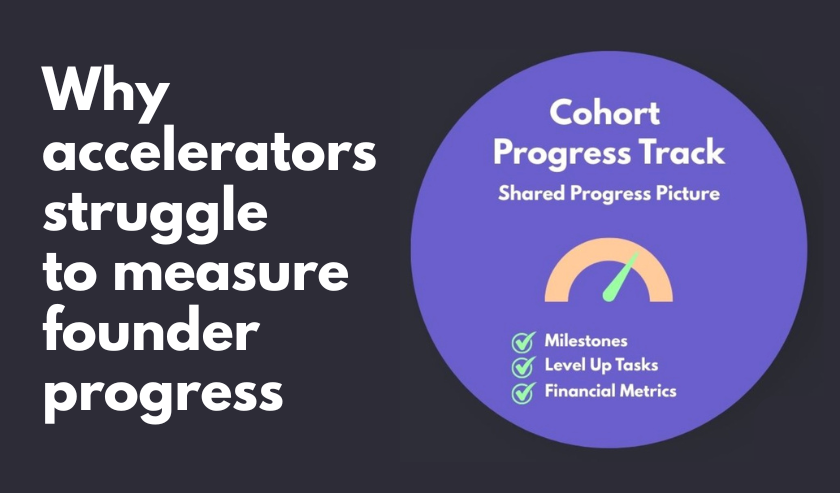
Most accelerators are busy, well-intentioned, and deeply invested in founder success. Yet many struggle with the same quiet problem: it's surprisingly hard to say, at any point during a cohort, how founders are actually progressing.
Coaches have their own mental models. Program managers rely on check-ins. Founders self-report in the best light available. By the time reporting is needed, progress gets reconstructed after the fact.
This works — until cohorts grow, programs scale, or accountability increases.
Why the visibility problem is harder than it looks
The challenge isn't effort or intent. It's structure.
Most programs are built around sessions. Between them, the program's view of founder progress goes quiet. When three coaches assess the same founder, they often reach three different conclusions — not because anyone is wrong, but because each is working from a different slice of the picture.
Founders compound this naturally. They're optimists by design, and self-reporting systematically overstates readiness. The gaps between what founders report and what's actually true are usually small — but they're exactly the gaps that matter most when investor conversations begin.
The space between sessions is where cohorts quietly diverge. Some founders use it well. Others lose a week to the wrong priority and arrive at the next session two steps back. Without visibility into that space, programs can only react late.
What the best accelerators do differently
The programs that consistently produce strong outcomes treat progress measurement as infrastructure, not administration.
In practice, that means three things.
1. They define what progress looks like before the cohort starts. Rather than leaving coaches to apply their own frameworks, they align around shared dimensions — market clarity, traction, team, investor readiness — and use these as a common language. Coaches still bring their own expertise. But they're applying it to the same map.
2. They make progress visible continuously, not just at reporting time. A founder who goes quiet for two weeks should trigger a conversation, not a blind spot. This doesn't require elaborate systems. It requires intentionality about what gets captured and when.
3. They use progress data to shape coaching, not just measure it. When a coach can see where a founder stood two weeks ago and where they stand today, sessions start from a specific place rather than a general catch-up. Founders feel the difference immediately — being coached by someone who knows your exact situation is a different experience from being coached by someone reconstructing it.
What this looks like in practice
Connect Sverige made this shift deliberately. Felicia Hedström, Growth Capital at Connect Sverige, describes what changed:
"Pitchago gave me a great overview of each company — where they were in their journey, what they were working on, and what they needed to focus on. It also offered the founders something to lean on when they weren't in mentoring sessions — a structured way to keep moving forward and stay aligned with their goals."
That last part is easy to miss. Progress infrastructure isn't just a tool for program management. Done well, it gives founders clearer direction between sessions — exactly when they need it most.
The compounding effect
When progress is visible from the start, the benefits build. Coaches align faster. Founders calibrate earlier. Gaps surface while there's still time to close them.
Programs that wait until the final stretch to assess readiness are measuring an outcome rather than managing a process. The result is reactive coaching and surprised founders.
The accelerators that get this right don't have better founders. They have better visibility — earlier. And they use it.